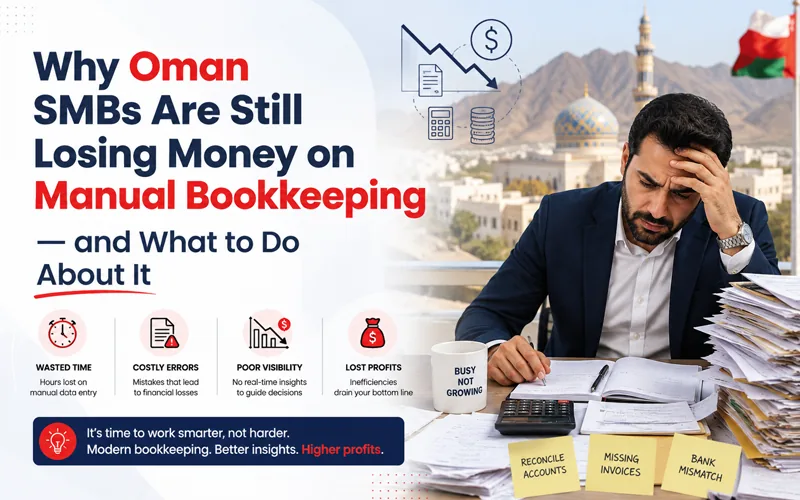
Most small business owners in Oman know roughly how much money came in last month. Very few know exactly how much went out — or where it went. The gap between those two numbers, multiplied across twelve months, is often the difference between a business that grows steadily and one that never quite understands why the bank balance does not match what the cash flow should be.
The cause is almost always the same: bookkeeping is being done manually, in arrears, by someone who is not an accountant, using tools that were not designed for the job. An Excel sheet. A notebook. A folder of receipts photographed to WhatsApp. These are not accounting systems — they are memory aids. And memory aids have a well-documented failure mode: when the business gets busy, the recording stops.
What Manual Bookkeeping Actually Costs
The direct costs of poor bookkeeping are easy to name. VAT is filed incorrectly because input tax credits are missed — not deliberately, but because the supplier receipt was never properly recorded. Expenses are paid twice because there is no clear record that the first payment cleared. Staff advances are made and never reconciled. A supplier is overpaid on a repeat order because no one checked the previous invoice against what was actually delivered.
These are not catastrophic events. Each one, individually, is a small loss. But they recur. A business processing forty supplier invoices a month and missing the VAT input credit on seven of them is losing real money every quarter — money that was legally recoverable and simply was not claimed because the paperwork was not in order at filing time.
The indirect cost is harder to quantify but arguably more damaging. A business owner who does not know their actual profit margin cannot make confident decisions about pricing. One who does not know their cash flow position for the next thirty days cannot negotiate supplier payment terms with any leverage. One who cannot produce a clean profit and loss statement when a bank asks for it cannot access the financing that would let the business expand.
Manual bookkeeping does not just cause errors. It withholds information. And running a business without financial visibility is, eventually, a matter of operating on instinct in situations that require data.
Why Oman SMBs Have Not Switched
The resistance to accounting software among small businesses in Oman is understandable. Most of the available tools were built for accountants — they assume the user knows what a chart of accounts is, understands the difference between a debit and a credit, and is comfortable creating journal entries from scratch. For a laundry owner, a salon manager, or a boutique operator who is running the counter, managing staff, and handling customers at the same time, that learning curve is not a minor inconvenience. It is a barrier that makes the alternative — a notebook and a monthly call to an external accountant — feel like the pragmatic choice.
The second reason is that basic accounting software does not connect to anything. The business has a billing system for its day-to-day operations and a separate, disconnected accounting tool that requires the owner to transfer data between the two manually. The manual transfer is itself another point of failure — and it replicates the same problem that the software was supposed to solve.

What Accounting Software Should Actually Do
The test for accounting software in a small business is not whether it produces a technically correct balance sheet. It is whether the business owner can understand what is in the software without an accountant translating it. Transactions should be described in plain language — Record Income, Record Expense, Move Between Accounts — not in the terminology of double-entry bookkeeping. Reports should answer real questions: Did we make money this month? How much do we owe suppliers? What is our VAT liability for the quarter?
Oman's 5% VAT requirement adds a specific layer to this. Every purchase from a VAT-registered supplier generates an input tax credit that can be offset against output tax on sales. Businesses that are not systematically recording their input tax credits are paying VAT on their full output — not just the net amount they legally owe. For a business with significant supply costs, the quarterly difference can be several hundred Omani Rials. Over a year, that is a material sum that belongs to the business and is being left unclaimed because the receipt was never recorded in a form that the VAT report can read.
Crystal Count: Accounting for Non-Accountants
Crystal Count was built specifically for this problem. It is an accounting management system designed for small and medium businesses in Oman — one where the person doing the bookkeeping is the owner or a business manager, not a chartered accountant.
Every transaction type is described in plain language. Income is recorded as income. Expenses are recorded as expenses. Moving money between accounts — from petty cash to the main account, from one company to another — is a named action with a clear description, not a journal entry that requires understanding which side of the ledger to put it on.
The standout feature is AI Receipt Scan. A business owner photographs a supplier invoice or receipt using the Crystal Count mobile interface. The AI reads the document, identifies the vendor, the amount, the date, and the VAT amount, and creates the accounting entry automatically. The three-line VAT journal — Expense debit, VAT Input Tax debit, Accounts Payable credit — is generated without the user needing to know that structure exists. The receipt is recorded, the VAT credit is captured, and the supplier balance is updated. In the time it takes to open a WhatsApp message and forward it to a folder, the transaction is in the accounts.
Oman's 5% VAT is built into every report Crystal Count produces. The VAT Report shows output tax collected, input tax paid, and the net amount due to the Oman Tax Authority — in the format needed for filing, not in a format that then needs to be translated into the filing format by hand. The Trial Balance, Profit and Loss, and Balance Sheet are available at any point in the financial year, not just at the end when the accountant asks for everything at once.
The Eight Reports That Replace Instinct with Data
Crystal Count produces eight standard financial reports. Day Book, Account Ledger, Account Statement, Trial Balance, Profit and Loss, Balance Sheet, Income and Expense Summary, and VAT Report. These are not reports that require an accountant to interpret. They answer specific questions that a business owner asks regularly: What transactions happened today? What does the supplier owe us? Did we make more than we spent this month? How much VAT do we owe?
The Profit and Loss report in Crystal Count is particularly useful for businesses that have previously relied on the difference between the opening and closing bank balance as their proxy for profitability. That number is not profit — it is net cash movement, and it includes things like loan repayments, asset purchases, and owner withdrawals that are not operating expenses. A proper Profit and Loss statement separates operating performance from financing activity. That separation is what makes pricing decisions, expansion decisions, and hiring decisions data-driven rather than intuitive.
Multi-Company Support
Many small business owners in Oman operate more than one business — a laundry and a boutique, a gym and a salon, two branches of the same trade under different commercial registrations. Crystal Count supports multiple companies from a single login. Each company has its own chart of accounts, its own fiscal year, its own VAT registration, and its own set of reports. The operator can switch between companies in a single session without logging out and back in — and can view the financial position of each entity independently.
This removes a common workaround where business owners maintain separate Excel files for each company and reconcile them manually at the end of the month. Each file is a separate maintenance burden. Each has its own error rate. Crystal Count replaces the collection of files with a single platform where each company's data is properly separated but accessible from one place.
The Practical Starting Point
The first step for any business moving from manual bookkeeping to Crystal Count is the company setup — entering the chart of accounts, the opening balance for each account, and the fiscal year start date. This is not a technical process. Crystal Count walks through it in a structured setup flow, and the Modern Digital World team handles the initial configuration as part of onboarding.
From that point, daily operation is straightforward. Income comes in — it is recorded in Crystal Count as income against the relevant account. A supplier invoice arrives — the owner scans it, the AI reads it, and it is in the accounts within thirty seconds. At the end of the quarter, the VAT Report is ready to review. At the end of the year, the Profit and Loss and Balance Sheet are current and complete.
The businesses that benefit most are those currently running on Excel or paper notebooks, those with VAT registration who are not systematically capturing input tax credits, and those with more than one company who are managing finances across separate, disconnected files. For each of them, Crystal Count is not a complexity upgrade — it is a simplification of a process that has become more complicated than it needs to be.
About Modern Digital World LLC
Modern Digital World LLC builds industry-specific business management software for retail and service operations across Oman and the GCC. Crystal Count is the company's accounting module for small and medium businesses — plain-language bookkeeping, AI receipt scan, Oman VAT compliance, and eight financial reports, with no accounting background required.
Book a free demo →