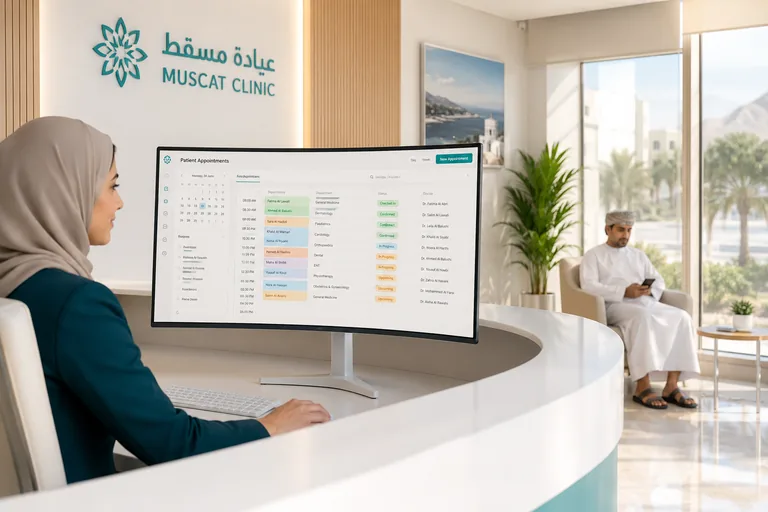
Ask any clinic receptionist in Oman how they manage appointments and the answer follows a predictable pattern: a WhatsApp number for bookings, a handwritten register for the day's schedule, and a folder of paper files behind the desk that has been growing since the clinic opened. The patient sends a message. The receptionist confirms a slot. The patient arrives, the doctor pulls a physical file, writes notes by hand, and the whole cycle repeats. It functions — until it does not. A file cannot be found when the patient arrives. A WhatsApp message about a booking came in at 11 p.m. and nobody saw it until noon the next day. The doctor is on leave and the covering physician has no access to the patient's history because it is in a folder locked in a cabinet.
This is not unique to any one clinic. It describes the operational baseline for a large proportion of general practice, dental, and specialty clinics operating across Muscat and the rest of Oman today. And the cost is not visible in a single incident — it accumulates daily in missed appointments, billing errors, insurance rejections, and patients who quietly choose not to return because the experience felt disorganised. The problem is structural, and it cannot be solved by adding more WhatsApp groups or more filing cabinets.
The Missed Appointment: Where Clinic Revenue Disappears Silently
A clinic's revenue is built on scheduled appointments. Unlike a retail business that generates walk-in traffic, a clinic operates on booked time — each slot has a fixed value, and an empty slot is revenue that cannot be recovered. In a manual booking system, no-shows and last-minute cancellations happen without warning. A patient who booked three days ago via WhatsApp may not remember the appointment by the time it comes around. There is no automated reminder, no confirmation nudge, and no system to fill a cancelled slot from a waiting list. The slot simply sits empty.
In a busy clinic with twelve to fifteen appointments per doctor per day, even a twenty percent no-show rate represents two to three lost consultations daily. Over a month, that is sixty to ninety billable consultations that generated no revenue — not because of anything the doctor did wrong, but because the reminder system that should have existed did not.
Purpose-built clinic software like Crystal Clinic addresses this at the booking stage. When an appointment is scheduled, the system automatically sends the patient a confirmation and a reminder twenty-four hours before. If the appointment is cancelled, the system surfaces the next patient on the waiting list and offers the slot. The receptionist does not need to track this manually — the system tracks it and surfaces the action required. Slots that would have sat empty get filled. The daily schedule becomes more predictable, and revenue that was quietly disappearing begins to be recovered.
Patient Data on WhatsApp: The Risk No Clinic Should Be Taking
When a patient sends their Emirates ID or Oman ID, insurance card, prescription, or test result over WhatsApp, that information sits in a personal messaging application on a staff member's phone — not in a secure, access-controlled system. When that staff member leaves, the conversation history and the patient data in it leaves with them unless someone thinks to archive it first. When a patient asks a follow-up question about their prescription two weeks later, the doctor or nurse has to scroll back through a chat thread to find the answer. There is no patient profile, no medication history, no allergy flag, and no structured record that can be retrieved in a consistent, auditable way.
This matters beyond operational inconvenience. Patient data carries legal and ethical obligations. Under Oman's Health Ministry guidelines and the broader expectation of medical confidentiality, clinics are responsible for how patient information is stored and who can access it. A WhatsApp thread on a personal phone does not constitute secure storage. It cannot be audited. It cannot be access-controlled. And if a patient's data is mishandled — shared accidentally, accessed by an unauthorised party, or simply lost when a device is replaced — the clinic is exposed to a regulatory and reputational risk that no paper register can quantify.
An electronic patient record system maintains each patient's data in a structured profile: demographics, visit history, diagnoses, prescriptions, allergies, and insurance details — all in one place, access-controlled by role, and retrievable in seconds. The doctor who covered yesterday's emergency knows the patient's history before they walk into the room. The receptionist can pull up an insurance card number without asking the patient to resend a photograph. The information is where it needs to be, when it needs to be there, without depending on anyone's memory of which WhatsApp conversation contains it.
Manual Billing: The Errors That Compound Every Month
Billing in a clinic that runs on paper involves multiple handoff points, each one a potential source of error. The doctor writes the consultation notes and prescribes treatment. Someone transfers the relevant charges to a billing sheet. The cashier processes payment. If the patient has insurance, a claim is prepared — usually manually, sometimes days after the visit — and submitted to the insurer. At every step, the accuracy of the final bill depends on information being transcribed correctly from one format to another, by different people, at different times.
The errors that result are often small individually: a service coded incorrectly, a co-payment calculated at the wrong rate, a treatment listed under the wrong patient. But they add up. Under-billing loses revenue. Over-billing creates disputes that require correction and can damage patient trust. Incorrect insurance codes result in claim rejections that require resubmission — adding days to the payment cycle and hours of administrative time. For a clinic processing forty or fifty consultations a day, even a modest error rate creates a continuous background drain on administrative capacity and cash flow.
An integrated billing module connects the clinical record directly to the charge sheet. When the doctor records a consultation, the associated fees are generated automatically. Insurance details already on the patient's profile feed into the claim. Co-payment rules are applied based on the patient's plan, not manually looked up and entered. Errors caused by transcription disappear because there is no manual transcription — the system carries the information from one stage to the next without a human intermediary.
The Prescription Chain: What Happens When Notes Live on Paper
A prescription written by hand is a single physical object. If the patient loses it, it is gone. If the pharmacy has a question about dosage, they call the clinic and hope the right person is available to answer. If the patient returns a month later with the same complaint, the doctor reviews the previous prescription from whatever notes are available in the file — assuming the file is present, the handwriting is legible, and the notes are complete enough to reconstruct the clinical reasoning.
Digital prescriptions solve several of these problems at once. The prescription is stored against the patient's record the moment it is issued. The patient can receive it electronically. The pharmacy can verify it without a phone call. The prescribing doctor can see the full medication history when the patient returns — current medications, past prescriptions, allergies flagged in the system — and make an informed clinical decision without having to reconstruct anything. For patients managing chronic conditions who visit regularly, this continuity of information is not a convenience — it is the foundation of safe, consistent care.
For multi-doctor or multi-branch clinics, the value increases further. A patient seen by one doctor at the Ghala branch can visit the Qurum branch and be seen by a different physician who has immediate access to the same clinical record. The care is continuous even when the provider changes. That level of coordination is simply not achievable with paper files and WhatsApp.
Insurance Claims: The Rejection Cycle That Drains Admin Time
Insurance billing is the most administratively intensive part of running a clinic in Oman. The process requires accurate procedure coding, correct patient insurance details, proper documentation of clinical justification, and submission within the insurer's required timeframe. When any one of these elements is wrong, the claim is rejected. The clinic then has to identify the error, correct it, gather any additional documentation, and resubmit — while also processing the next batch of claims, managing day-to-day operations, and handling the patients who are asking why their insurance did not cover something they expected it to.
Manual claim preparation — where staff translate handwritten doctor notes into insurance submission formats — has a high error rate by design. The information passes through too many hands, in too many formats, with too many opportunities for a digit to be transposed or a code to be entered incorrectly. Each rejection adds to a resubmission queue that grows faster than the admin team can clear it during busy periods.
Clinic software with integrated insurance management captures the clinical information and generates the claim documentation in the correct format for submission. Patient insurance details are validated at registration, not discovered to be incorrect when the claim is rejected three weeks later. Procedure codes are selected from a standardised list rather than manually keyed in. The result is a substantially lower rejection rate, faster payment cycles, and an admin team that spends its time on patient service rather than chasing insurer corrections.
What a Clinic's Day Looks Like With the Right System
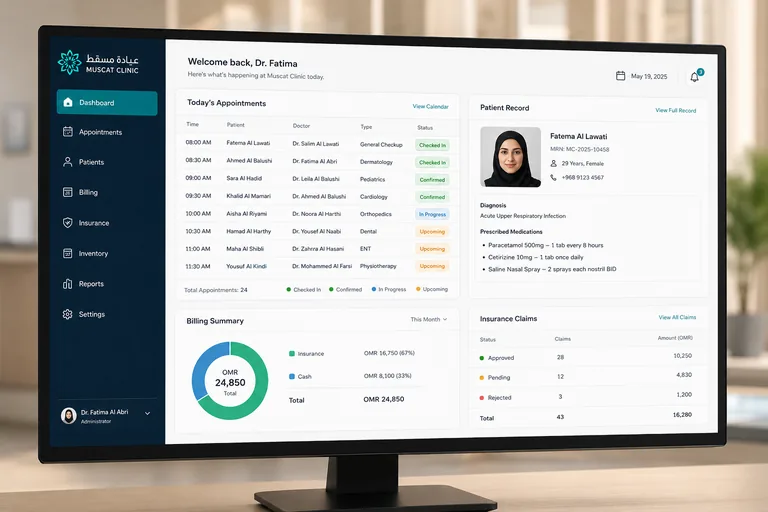
The morning begins with a complete schedule already visible — confirmed appointments, patients on the waiting list, any insurance pre-authorisations that are still pending. Reminders went out automatically the day before. The no-show rate is lower than it was six months ago. Patients who arrive are checked in through the system in under a minute. Their records pull up immediately: last visit, current medications, allergies, insurance plan, outstanding balance if any.
The doctor finishes a consultation, adds a note, prescribes treatment, and orders a follow-up. The billing system has already generated the charge based on what was documented. The receptionist reviews it, processes payment or routes it to insurance, and the patient is on their way. At the end of the day, the clinic manager looks at a dashboard: how many patients were seen, what revenue was collected, what is queued for insurance submission, and which follow-up appointments are due to be booked. No spreadsheet is opened. No file cabinet is unlocked. No WhatsApp thread is searched.
This is what Crystal Clinic is designed to produce — not a technology transformation, but an operational one. The clinic's staff do the same work they have always done: they see patients, they care for people, they coordinate schedules. The system handles the information flow that sits beneath all of that, so the people can focus on the part that requires their expertise rather than their memory.
For Oman's clinics, the environment is becoming more competitive. Patients have more options. Their expectations — shaped by experiences in banking, retail, and other sectors — have risen. A clinic that loses a paper file, misses a reminder, or takes three weeks to process an insurance claim is not just creating an administrative problem. It is creating an experience that patients notice and remember. The clinics building a durable patient base in this environment are the ones that have made the operational foundation — the records, the appointments, the billing — invisible in the best sense: reliably handled, every time, without effort from the patient or the staff.
About Modern Digital World LLC
Modern Digital World LLC builds industry-specific business management software for retail and service operations across Oman and the GCC. Crystal Clinic is our dedicated clinic management system — built for general practice, dental, dermatology, and multi-specialty clinics operating in Oman, covering appointments, patient records, prescriptions, insurance billing, and pharmacy in a single integrated platform.
Book a free demo →