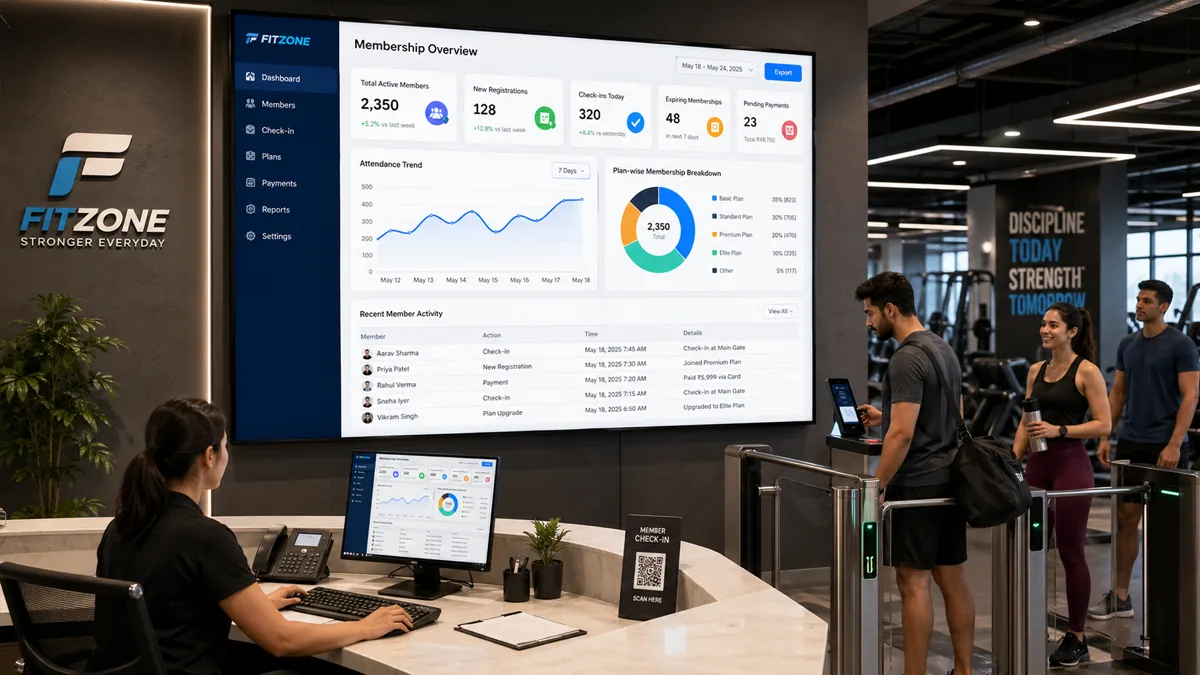
Ask any gym owner in Oman how they manage memberships and the answer is almost always some combination of a WhatsApp group, a shared spreadsheet, and a receptionist who has memorised which members are up for renewal this week. It works — until it does not. A receptionist leaves. The spreadsheet has two versions and nobody is certain which is current. A member who renewed in cash last Thursday is not in the sheet yet, and the person who took the money is not in today. Meanwhile, four memberships expired silently three weeks ago and those members are still coming in because nobody flagged it.
This is not a staffing problem or a discipline problem. It is a systems problem. And it is costing Oman's fitness clubs more than most owners realise — not in one dramatic loss, but in a quiet, daily erosion of revenue, member retention, and operational control that never shows up cleanly on any report because the report itself is the problem.
The Renewal Gap: Where Most Gym Revenue Disappears
A gym's financial model depends almost entirely on two things: converting walk-ins to members, and keeping existing members renewing. The second is far cheaper than the first — a retained member costs nothing to acquire and already trusts the facility. Yet most gyms in Oman invest heavily in marketing for new members while leaving retention almost entirely to chance.
The renewal gap opens when a membership expires and nothing happens. In a manual system, there is no automatic trigger. A member who stopped coming two weeks before their expiry date is still marked active. Nobody calls. Nobody sends a message. By the time the lapse is noticed — usually when that member appears at the front desk and the receptionist manually checks the sheet — the member has either quietly moved on or is annoyed at the lack of follow-up. In competitive markets, that is not a recoverable situation.
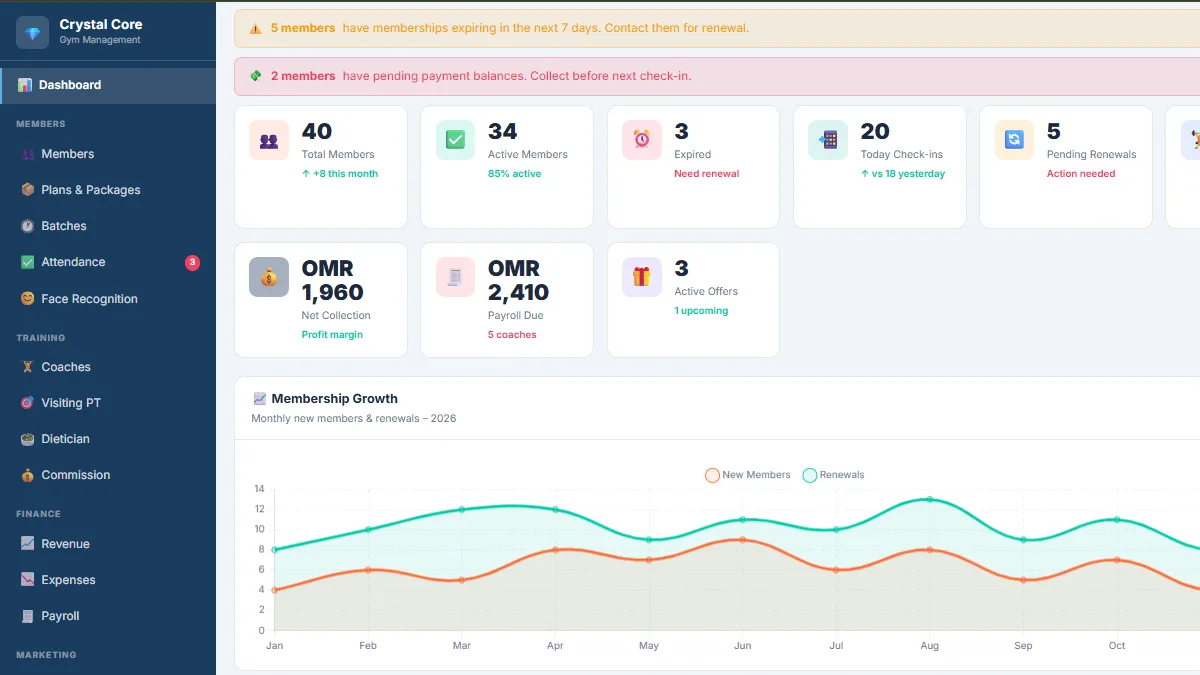
Purpose-built gym management software like Crystal Core closes this gap automatically. Every membership has a defined end date. Days before expiry, the system sends the member a renewal reminder via SMS or WhatsApp. If they do not renew, a second reminder goes out on expiry day. The front desk receives a daily alert listing every expired and expiring membership. Nothing depends on a receptionist remembering. Nothing depends on checking a spreadsheet. The system tracks it and surfaces it — the staff act on information the system has already gathered.
The Attendance Signal That Most Gyms Ignore
Members who are about to churn almost always give a signal before they leave: they stop coming. Attendance drops from four sessions a week to two, then to one, then to nothing. In a manual system, this pattern is invisible. There is no mechanism to notice that a member who was coming in every other day has not been seen in eleven days — not until their membership expires and the loss is already complete.
Gym management software tracks every check-in against the member's profile. When attendance drops below a member's personal average, the system flags it. A manager or trainer can reach out proactively — a check-in message, a class recommendation, a personal session offer. The outreach costs almost nothing. The alternative — replacing a churned member with a new acquisition — costs significantly more in marketing spend and staff time.
This is the part of gym software that surprises owners most when they first see the numbers. Retention is not a relationship skill — it is a data problem. The relationship matters, but it can only be applied if someone knows where to apply it. The system provides that knowledge.
Trainer Scheduling: The Hidden Cost of Manual Coordination
Personal training is typically a gym's highest-margin service. A dedicated trainer working full sessions generates more revenue per square metre than any group class. But in most gyms, trainer scheduling is managed through — again — WhatsApp. A member messages the trainer directly. The trainer checks their mental calendar, confirms a time, and the session happens. Or does not. Double-bookings, forgotten sessions, and no-shows are routine. And because the booking exists only in a WhatsApp thread, there is no record, no tracking, and no ability for management to know what the trainer's actual utilisation looks like.
With dedicated scheduling software, personal training sessions are booked through the system. The trainer's availability is visible. The member selects a slot, the system confirms it, and both parties receive a reminder before the session. Cancellations are recorded. No-shows are tracked. Management can see, at any point, which trainers are fully booked, which have available slots, and what the revenue per trainer looks like week over week. That data directly informs decisions about hiring, scheduling, and which trainers to assign to new members.
Access Control: The Membership Abuse Nobody Talks About
In gyms without a proper check-in system, membership sharing is common knowledge that everyone quietly ignores. A member hands their access card to a friend. Two people use one membership. In isolation, this seems minor. At scale — in a club with 400 active members — it represents a meaningful slice of capacity being consumed by people who are not paying for it. More importantly, it means the gym has no accurate picture of its actual footfall, which makes every operational decision — staffing levels, equipment purchases, class scheduling — based on distorted data.
Crystal Core's check-in module ties each entry to a verified member profile. Entry requires either a member card scan or a mobile QR code that is unique to the account. Shared codes are flagged automatically when the same credential is used in a pattern inconsistent with a single person's routine. Management sees real check-in data, not a count that includes unpaid guests. The gym knows exactly who is using the facility and when — which is the foundation of every other operational decision.
Class Management: Filling Slots That Would Otherwise Go Empty
Group fitness classes are a retention tool as much as a service. Members who attend classes consistently renew at a substantially higher rate than those who only use the gym floor — because classes create routine, community, and accountability. But classes also require coordination: instructors, room or studio availability, and a cap on participants. Without a booking system, gyms either run classes open-entry — which makes it impossible to predict attendance and staff accordingly — or they manage bookings manually, which means more WhatsApp messages and more opportunities for miscommunication.
A class booking module lets members reserve spots in advance through a simple interface. The gym sees confirmed attendance before the class begins. Instructors know their headcount. Waitlists fill automatically when spots open. And management can track which classes are consistently oversubscribed — a direct signal for where to add sessions or expand capacity — and which classes are underperforming and may need to be rescheduled or reformatted.
The Revenue Picture a Gym Should Be Seeing Every Day
Ask a gym owner what their revenue was last month and most can give you a figure — eventually, after checking a few places. Ask them what their member churn rate was, which membership tier has the highest renewal rate, which trainer generated the most session revenue, or what percentage of walk-in trials converted to memberships, and the answer is usually a pause followed by an estimate.
These are not obscure metrics. They are the numbers that determine whether a gym is growing or slowly losing ground to the competition down the road. A gym with 350 members and a 15% monthly churn rate is replacing 52 members a month just to stay flat — a marketing burden that compounds quickly as the market tightens. A gym with the same 350 members and an 8% churn rate is growing on the same marketing budget. The difference is almost always in how systematically the gym handles renewals, follow-ups, and member engagement.
Purpose-built gym software surfaces these numbers automatically. Owners and managers see daily dashboards that show active memberships, upcoming renewals, expired accounts, session bookings, and revenue breakdown — without generating a single manual report. The information exists because the system captures every transaction, every check-in, and every booking as it happens. Decisions stop being based on gut feel and start being based on what is actually occurring in the business.
What the Switch Actually Looks Like
A common concern among gym owners considering software is disruption: migrating member data, retraining reception staff, and managing a transition period while the gym is still running. In practice, the transition is simpler than most expect. Member profiles are imported from existing spreadsheets. Staff learn the system in a day — the core workflows are designed to match what they already do, just with the system doing the tracking instead of them. Within two weeks, the manual processes that were holding the operation together are no longer necessary because the software has replaced them with something faster and more reliable.
The ROI appears quickly. Renewal reminders recover memberships that would previously have lapsed without follow-up. Accurate check-in data identifies membership sharing that was silently consuming capacity. Trainer utilisation reports show where revenue is being left on the table. Attendance tracking flags at-risk members before they churn. None of these outcomes require the gym to operate differently — they require the gym to see what is already happening, clearly, in real time.
For Oman's fitness clubs, the competitive environment is tightening. New gyms are opening. Members have more choices. The clubs that retain their members most effectively — through consistent follow-up, personalised engagement, and smooth operations — are the ones that build a durable business. That consistency is not achievable through WhatsApp groups and manual spreadsheets. It requires a system designed for exactly this purpose.
About Modern Digital World LLC
Modern Digital World LLC builds industry-specific business management software for retail and service operations across Oman and the GCC. Crystal Core is our dedicated gym and fitness club management system — built from the ground up for membership-based businesses, not adapted from a generic platform.
Book a free demo →