Every car wash owner knows the pricing list. A small hatchback is one price. A mid-size sedan is another. An SUV, a pickup truck, a luxury coupe — each has a rate that reflects the extra time, water, product, and effort involved. The pricing structure makes obvious sense. What is less obvious — until you start looking at the numbers — is how often that structure is quietly bypassed.
A Toyota Land Cruiser pulls in. The attendant keys in the booking. The vehicle is logged as a compact. The customer pays the small-car rate. The owner sees a completed job and a collected payment. The difference between what was charged and what should have been charged disappears. Multiply that across thirty vehicles a day and the monthly revenue leak becomes significant — not from any single obvious theft, but from dozens of small, invisible adjustments made at the point of entry.
The Root of the Problem: Manual Vehicle Entry
In most car wash stations operating without dedicated software, the booking process is entirely manual. An attendant writes down — or types in — the vehicle details at their discretion. There is no verification step. The system, if one exists at all, accepts whatever is entered. A Nissan Patrol can become a sedan in two keystrokes. A BMW 7 Series can be logged as a standard saloon.
This is not always deliberate fraud. Sometimes it is carelessness — an attendant who genuinely does not know the difference between vehicle categories, or one who is moving quickly through a queue and picks the wrong option. But whether intentional or accidental, the financial impact on the business is the same: you are washing big cars for small prices, and your revenue report will never tell you why your margins keep shrinking.
How LPR Changes the Equation
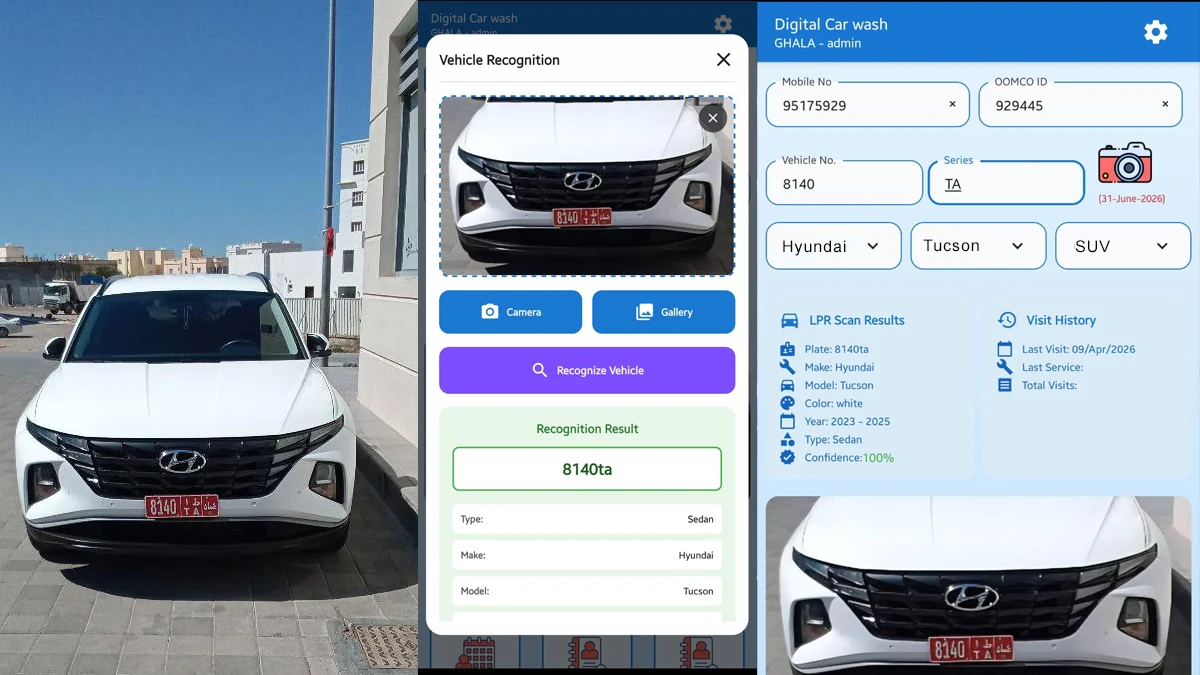
Crystal Cars uses License Plate Recognition (LPR) to capture vehicle details the moment a car enters the station. The camera reads the plate automatically — no manual entry, no attendant discretion, no opportunity for substitution. The plate number is logged against the booking before a single door is opened.
But plate capture alone only solves half the problem. A plate tells you who owns the vehicle; it does not tell the system what type of vehicle it is. This is where vehicle brand and model recognition comes in. Crystal Cars identifies the make and model of the car from the entry frame — distinguishing a compact from an SUV, a standard saloon from a large luxury vehicle. The system knows what pulled in. The correct pricing tier is applied automatically, without requiring the attendant to make any selection at all.
The practical result: the attendant cannot — even unintentionally — log a Land Cruiser as a Yaris. The system has already determined what the vehicle is and what it should cost. The booking is created at the right price, and that price is locked.
Stage-by-Stage Staff Accountability
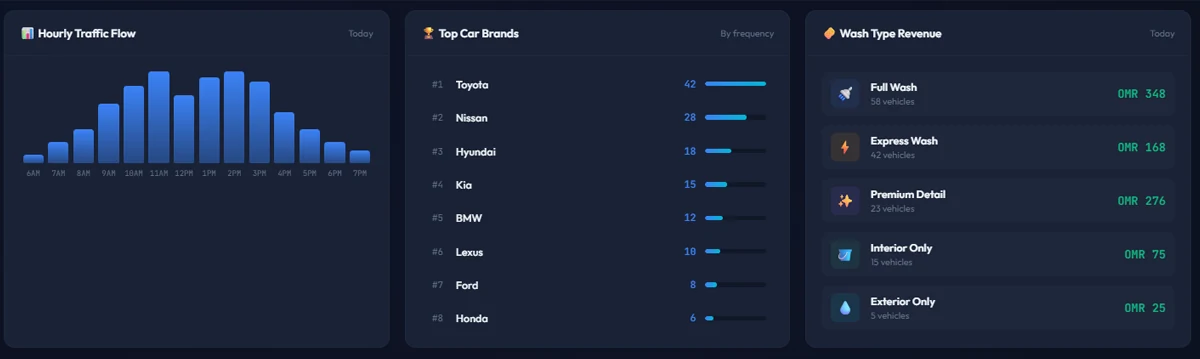
Accurate billing at entry is the first layer of control. The second is what happens after the car is inside the station. Crystal Cars tracks staff performance across every stage of the service workflow: Invoicing, Washing, Vacuum, and Delivery.
Each stage is time-stamped and assigned to the individual who completed it. If a vehicle spends forty minutes in the wash bay but only fifteen minutes are logged, that gap is visible. If the delivery stage is skipped entirely and the car is returned without a final inspection, the system records the absence. Owners and managers get a real-time view of where each vehicle is in the process, how long each stage is taking, and which staff members are consistently fast, consistently slow, or consistently skipping steps.
This matters for more than just accountability. Stage tracking tells you where your bottlenecks are. If the vacuum stage is consistently the slowest, that is an operational insight — perhaps you need an additional staff member assigned there during peak hours. If one attendant's delivery times are twice the station average, that is a training conversation waiting to happen. The data does not require interpretation; it simply shows you what is occurring.
Customer Ratings That Close the Loop
After a vehicle is delivered, Crystal Cars sends the customer a digital link to rate their service experience. The feedback is tied directly to the specific booking — the vehicle, the date, the staff involved, the stages completed. It is not a generic satisfaction survey. It is a precise record of how a customer felt about that particular wash, on that day, by those particular staff.
Over time, these ratings build a performance history for each team member and for the station as a whole. A consistently low rating from customers who collected their vehicles after a particular attendant's shift is a signal that manual inspection would never catch. A sudden dip in ratings after a new process change tells you the change is not landing well. Positive feedback, equally important, tells you what to protect and replicate.
The combination of LPR, stage tracking, and customer ratings creates an environment where quality is measurable rather than assumed — and where accountability is built into the daily workflow rather than enforced through supervision alone.
What This Means for Car Wash Owners in Oman
Car wash stations in Oman range from small neighbourhood operations to multi-bay facilities serving dozens of vehicles daily. At every scale, the same vulnerabilities exist: manual pricing decisions at the point of entry, limited visibility into what happens between entry and delivery, and no structured mechanism for capturing how customers actually feel about the service.
Crystal Cars was built to address all three. The LPR and brand recognition layer removes pricing discretion from the equation — vehicles are identified and priced by the system, not the attendant. Stage tracking makes the service workflow transparent and auditable at every step. Customer ratings provide an independent quality signal that no internal process can manufacture.
For an owner managing from an office or reviewing end-of-day reports remotely, this means the data you see reflects what actually happened — not what was manually entered. For a station that has been struggling to understand why revenue is lower than expected despite high vehicle volumes, the answer is often in the first report Crystal Cars generates: the gap between what was washed and what was billed.
About Crystal Cars
Crystal Cars is a car wash station management system by Modern Digital World LLC — purpose-built for Oman. LPR, brand recognition, stage tracking, and customer ratings in one platform. Book a free demo and see how it works in your station.
Book a demo →