
Spreadsheets are where most Oman SMEs start. They're free, familiar, and surprisingly powerful for a business of two or three people. But there comes a point — usually somewhere between 10 customers and 10 employees — where the cracks start to show. Here are five signs you've already crossed that line.
1. You Can't Answer Basic Questions Without Digging
The test is simple. If someone asks you — right now — how many customers you served last month, what your busiest day of the week has been this quarter, or what your top five selling services were in March, can you answer in under a minute? If the honest answer is "I'd need to open a few files and check," the problem is not that you lack the data. The problem is that the data lives in the wrong place. Meaningful questions about your own business should not require thirty minutes of spreadsheet archaeology.
A management system answers these questions in real time, from any device, without opening a single file. Revenue by day, staff performance by individual, stock levels at this moment, outstanding payments — all on one dashboard. The shift from "let me check and get back to you" to "here it is" is more significant than it sounds. It changes how quickly you can respond to problems, how confidently you can plan, and how much of your working day is spent on decisions rather than data retrieval.
2. Staff Are Wasting Time on Data Entry
Think about how many times a single piece of information gets written down in your business. A customer calls to book an appointment: the name goes in the appointment book. When they arrive, their name goes on the invoice. When payment is collected, the cashier notes it in the daily sheet. If they are a loyalty member, their visit gets logged separately. That is the same customer's name entered four times by two or three different people, each of whom could introduce a typo, skip a step, or disagree with how the name was spelled last time. When two staff members edit the same shared sheet simultaneously, one of them overwrites the other's work and neither knows it happened.
The mathematics are straightforward: two front-desk staff spending 45 minutes each per day on duplicate data entry adds up to more than 45 hours of paid time every month producing no value for the customer and no revenue for the business. A management system captures data once at the point of entry and flows it automatically to every report, invoice, and record that needs it.
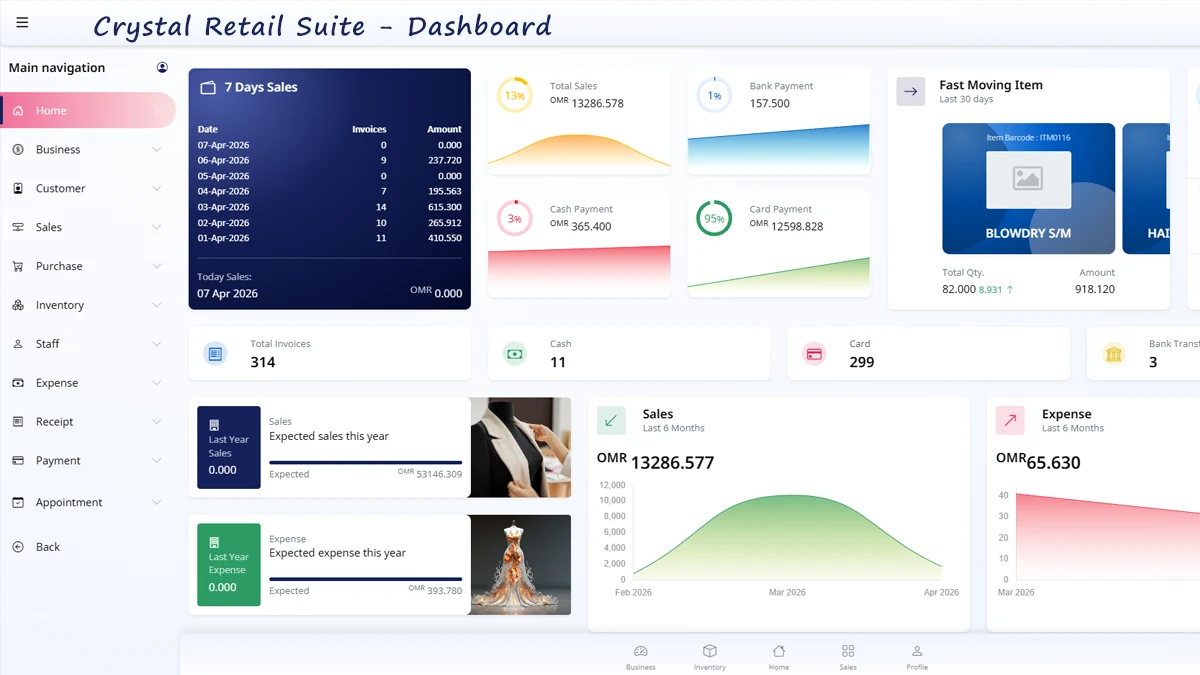
3. A Mistake by One Person Breaks Everything
Spreadsheets are fragile in a way that is easy to underestimate until it goes wrong. One accidental delete that removes a column of historical data. One formula with an extra space that returns zeros for every cell in a report. One sort operation applied to selected columns rather than the whole table, silently misaligning six months of records. The spreadsheet has no audit trail — there is no log of who changed what and when. There are no user permissions — a casual staff member has the same ability to edit historical invoices as the owner. There is no rollback — if the damage is saved and the file is closed, the previous state is gone.
Business management software is built around a different principle entirely. User roles determine what each person can see and do: a cashier can process a sale but cannot edit a historical invoice. A supervisor can view all sales reports but cannot modify a product price without manager authorisation. An administrator has full access, but every action they take is logged with a timestamp and a username. If something looks wrong, you can trace exactly what happened, who did it, and when.
4. You Don't Know What Stock You Actually Have
In any business that holds physical inventory — a salon with product retail, a laundry with consumables, a boutique with clothing stock — the "current stock" figure in a spreadsheet is almost certainly wrong. It reflects what someone counted the last time they did a physical stocktake, minus whatever they remembered to update since then. Over-ordering based on inaccurate numbers ties up cash in excess stock. Under-ordering based on the same inaccurate numbers means telling a customer you do not have something when a smarter system would have flagged the low-stock situation a week earlier.
Real-time inventory tracking works differently: every sale automatically deducts the relevant items from stock. Every service that consumes a product updates the count. Low-stock alerts fire when a defined threshold is crossed, long before the shelf is empty. Reorder history is one click away. The stock figure you see on screen is the stock figure you actually have — not an approximation from the last manual count.
5. You Have More Than One Version of "The Truth"
This is the sign that appears latest and causes the most damage. The operations manager has April's revenue figures in a file on their laptop. The accounts team has a different number in their accounting sheet. The owner has a third figure on their phone because they compiled their own summary two weeks ago. Nobody is wrong in the sense of having made up a number — but the three figures do not agree, nobody is entirely sure which one to trust, and reconciling them requires a meeting that takes two hours and produces a consensus that nobody is fully confident in.
A single-source-of-truth system means that every person with access to the business data sees the same live figures, updated in real time. There is nothing to reconcile because there is only one version. Month-end closing changes from a multi-day exercise in cross-referencing conflicting files to a one-hour review of a report that has been building itself automatically all month.
What to Do Next
The right time to switch from spreadsheets to a management system is before a crisis, not after one. If you recognise two or more of the five signs above, the operational cost of staying where you are is already higher than the cost of making the change. The evaluation process does not need to be complex: identify the two or three workflows that cause the most pain right now, request demonstrations from vendors who serve your specific industry, and prioritise a system that your staff can learn to use without a week of training. The best software is the software that actually gets used.
Modern Digital World's Crystal platform covers retail, spa and salon, laundry and dry cleaning, boutique and fashion, gaming zone, and car wash management — all built for Oman's SME market with Arabic language support, local data hosting, and a Muscat-based support team. A free 30-minute demonstration requires no commitment and no sign-up. If after seeing it you decide it is not the right fit, you have lost thirty minutes. If it is the right fit, you have found the last spreadsheet you will ever need to maintain.
About Modern Digital World
Crystal business software replaces spreadsheet chaos with a single, clean system built for Oman SMEs. Book a free demo and see the difference in 30 minutes.
Book a demo →